
How The Dwyer Company Underpinned a Settling Fire Station in Union, Kentucky
- Project Type: Commercial
- Project Services: Deep Foundation Systems, Helical Piles, Shoring/Underpinning
The southern end of the Union Fire Station was settling, and the movement had reached the building, showing along the western and southern wall lines. The Dwyer Company worked with Civil Solutions (engineer) to install 19 helical underpins on 2-7/8″ diameter shaft with a single 12 inch helix, taking each one to bedrock at 9 to 10.5 feet and designing for 15 kips in compression and 5 kips in tension. Utilities ran through the work area, so crews maneuvered around them at every location. The two affected wall lines now bear on bedrock, and the job closed in one week.
Seeing settlement damage in a building that has to stay in service?
Quick Facts
- Union, Kentucky
- Project Type: Commercial – Repair
- Timeline: 1 week
- Foundation System: 19 helical underpins, 2-7/8" diameter shaft, 0.217 wall, single 12 inch helix
- Design Capacity: 15 kips in compression, 5 kips in tension
- Bearing Depth: Bedrock, encountered between 9 and 10.5 feet
- Site Conditions: Existing utilities running through the work area
- Owner: Union Fire Station
- Partners: Civil Solutions (engineer)
The Challenge
Settlement at the south end of the Union Fire Station had progressed far enough to damage the building, with movement showing along the western and southern wall lines. Settlement of that kind keeps going while the soil under the footing keeps yielding, so the repair had to reach material that would hold and then transfer the building onto it.
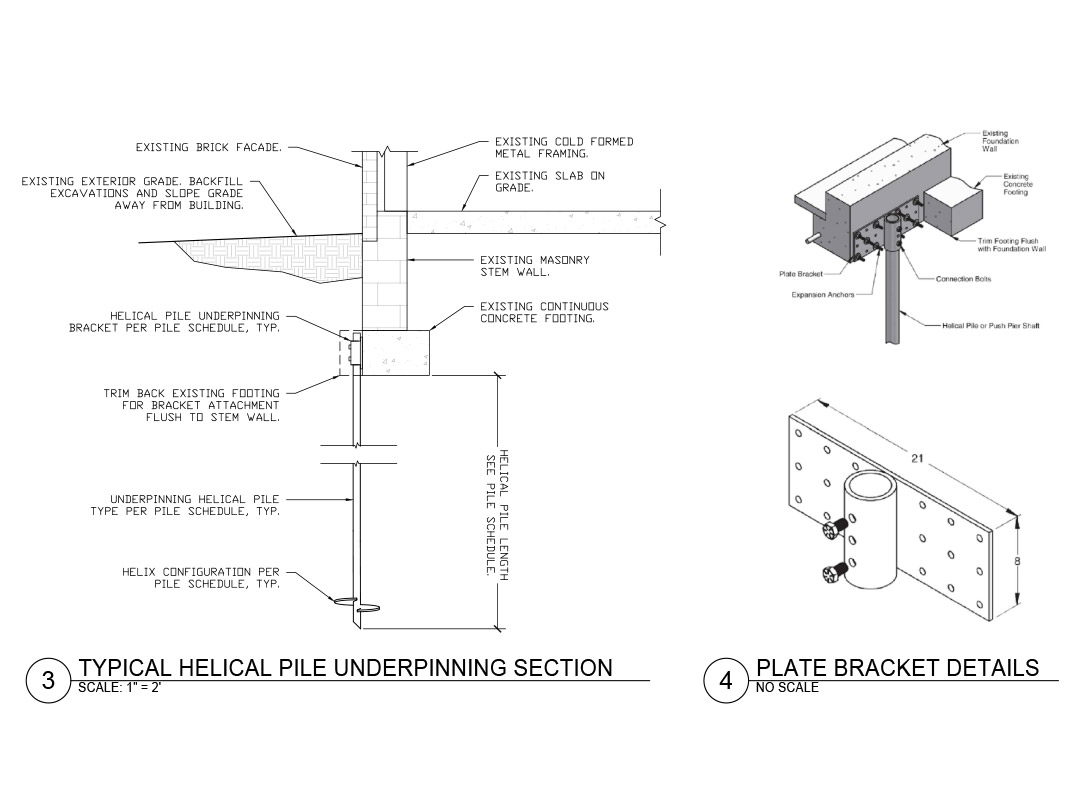
Utilities shaped how the work got done. Lines ran through the areas where the underpins had to go, and each bracket location sits directly against the existing footing, which left little room to shift a pier over to a friendlier spot. Crews located the utilities and maneuvered the excavations and equipment around them along both wall lines.
Key Project Details
helical underpins installed along the western and southern wall lines
2-7/8″ diameter shaft, 0.217 wall, single 12 inch helix
Installed to bedrock, encountered between 9 and 10.5 feet
Designed to support 15 kips in compression and 5 kips in tension
to complete
The Solution: Helical Underpinning System
Civil Solutions and The Dwyer Company specified a helical underpinning system for the two moving wall lines. Crews installed 19 underpins on 2-7/8″ diameter shaft with 0.217 wall and a single 12 inch helix, advancing each one to bedrock between 9 and 10.5 feet, with a design capacity of 15 kips in compression and 5 kips in tension. Underpinning brackets at the footing carry the wall loads into the shafts and down to rock, past the soils that had been giving way.
Getting there took care around the utilities. Crews located the lines running through the work area and maneuvered the excavations and equipment around them, then set the underpins in sequence along the western and southern walls. The whole scope, 19 underpins on two wall lines, closed in one week.
The Impact
Four things came out of the week at the Union Fire Station.
Settlement stopped at the source
The underpins carry the western and southern wall lines on bedrock, so the yielding soils under the original footing no longer determine how the building sits.
Bearing confirmed on bedrock
Bedrock came in between 9 and 10.5 feet, and every underpin went to it, which makes the bearing condition verifiable rather than assumed.
Utilities stayed intact
Lines ran through the work area at both wall lines, and the crew located and worked around them at all 19 locations.
One week at an emergency services building
The full scope finished inside a week, which limited how long the station had a foundation crew working against its walls.
Why Helical Underpinning?
Helical underpinning suited a building that had to be stabilized where it stood, on a site where buried utilities ruled out large excavations.
- Reaches competent bearing – Shafts advance until the helix reaches rock or a stiff stratum, so each underpin bears on real material at whatever depth it turns up.
- Capacity verified during installation – Torque correlates to capacity, giving confirmation at each location as the crew works down the wall.
- Small excavations – Each underpin needs only a modest hole at the footing, which is what makes work around buried utilities possible.
- Compression and tension in one element – The same underpin resists downward load and uplift, useful where a wall line moves in more than one direction.
- Installs year-round – The system takes load as soon as it is connected, with no cure time between install and support.
Why Choose The Dwyer Company for structural integrity?
Deep History • Solid Choice
The Dwyer Company’s proven track record in commercial and industrial foundation systems made us the trusted partner for the Union Fire Station repair. Working with Civil Solutions, the team put 19 helical underpins to bedrock under two settling wall lines and finished in a week.
Have a public building showing settlement damage?