
How The Dwyer Company Stabilized a Settling Maintenance Building in Silver Grove, Kentucky
- Project Type: Commercial
- Project Services: Deep Foundation Systems, Helical Piles
Construction on a Silver Grove, Kentucky maintenance building was nearly finished when a waterline was struck and the building began settling fast. The site sits over 30 feet of fly ash soils, which lose strength quickly once water reaches them, so the movement had to be stopped before it took the schedule with it. The Dwyer Company mobilized on an emergency basis and installed 53 micropile underpins, each designed to support 35 kips in compression and each extending 45 to 50 feet. The underpinning stopped the settlement and held the construction schedule.
Facing sudden settlement on a build that is nearly complete?
Quick Facts
- Silver Grove, Kentucky
- Project Type: Commercial – Emergency Repair
- Completed: May 31, 2023
- Foundation System: 53 micropile underpins
- Micropile Capacity: 35 kips in compression, each pile
- Pile Depth: 45 to 50 feet
- Soil Conditions: 30 feet of fly ash soils
The Challenge
Fly ash behaves well enough until water finds it. When the waterline was struck, 30 feet of fly ash soils under the maintenance building lost strength in a hurry, and the structure started dropping while the rest of the site was finishing out. Every day of movement put the completion date further at risk, so the repair had to start immediately.
Access made it harder. The piles had to go in inside the maintenance building, under limited headroom and through a footprint crews could barely get equipment into. Emissions ruled out diesel indoors, so an electric machine did the work. Below grade, crews threaded around live utilities, rebar in the existing foundations, and the geo-piers already installed as part of the original design. Other trades were still working the site throughout.
Key Project Details
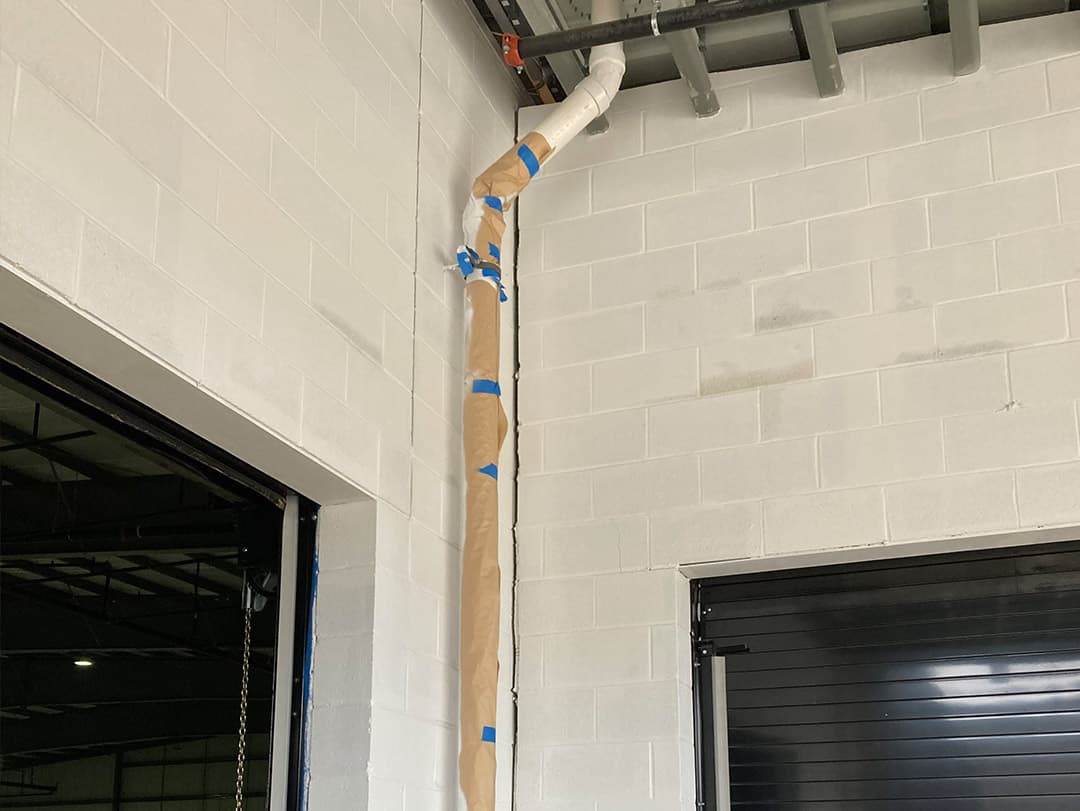
micropile underpins installed to stabilize the maintenance building
The Solution: Micropile Underpinning
The Dwyer Company designed a micropile underpinning system sized for the compromised soils: 53 piles, each carrying 35 kips in compression, each taken 45 to 50 feet down so the load transfers well below the fly ash that had failed. Micropiles suited the job because the equipment is small enough to work inside a finished building and the pile itself develops high capacity in a small diameter.
Execution came down to what crews could fit and what they could not disturb. An electric machine handled the interior piles, which kept exhaust out of an enclosed space and let the work continue while other trades stayed on site. Crews located every pile around existing utilities, foundation rebar, and the geo-piers already in the ground, then installed and connected each one to the foundation. The building stabilized and the general contractor kept the completion date.
The Impact
Quick action on an emergency call
The Dwyer Company mobilized on short notice and started underpinning while the building was still moving.
Schedule protected
The repair ran alongside the remaining construction work, so the project stayed on its original timeline.
Engineered for failing soils
Each of the 53 micropiles was designed for 35 kips in compression and taken 45 to 50 feet, past the fly ash that had lost strength.
Precision around existing work
Crews installed every pile without disturbing live utilities, foundation rebar, or the geo-piers already in place.
Why Micropiles?
Micropiles let The Dwyer Company underpin a building from the inside, in a space too tight and too low for conventional deep foundation equipment.
- Small footprint, low headroom – the rigs fit inside finished buildings and basements where larger equipment cannot go.
- High capacity per pile – a small-diameter pile carries heavy structural loads, so fewer connections are needed at the footing.
- Installs through obstructions – micropiles can be advanced past existing foundations, fill, and debris that would stop other systems.
- Low vibration – installation stays gentle enough to work next to finished construction and occupied space.
- Load transfer to competent material – the pile carries the structure well below weak or water-sensitive soils.
Why Choose The Dwyer Company for structural integrity?
Deep History • Solid Choice
The Dwyer Company’s proven track record in commercial and industrial foundation systems made us the trusted partner for this emergency underpinning. The team designed, mobilized, and installed 53 micropiles inside an active jobsite without costing the project its completion date.
Have a structure moving on a schedule that cannot slip? Let us take a look.