
How The Dwyer Company Built a Foundation Through Soft Soils at Deming Park Pool
- Project Type: Commercial
- Project Services: Deep Foundation Systems, Helical Piles
Deming Park Pool in Terre Haute, Indiana planned an addition to its family bathroom along with a new roof over the equipment yard. Soft soils ran through the upper 6 to 14 feet of the site, and both structures had to go up next to buildings already standing. The Dwyer Company worked with Civil Solutions (engineer) and general contractor Garmong & Sons, Inc to install 12 helical piers between 10 and 16 feet deep, extending past the soft material into stiff to very stiff soils, each pier supporting 12 kips in compression and tension. Crews finished in two days.
Building an addition on soft soils next to an existing structure?
Quick Facts
- Terre Haute, Indiana
- Project Type: Commercial – Retrofit
- Timeline: 2 days
- Foundation System: 12 helical piers, 10-12-14 helix configuration, 0.217 wall
- Pier Capacity: 12 kips in compression and tension
- Pier Depth: 10 to 16 feet
- Soil Conditions: Soft soils through the upper 6 to 14 feet, over stiff to very stiff bearing soils
- Partners: Garmong & Sons, Inc (general contractor), Civil Solutions (engineer)
The Challenge
Deming Park Pool wanted two additions: more room in the family bathroom and a roof over the equipment yard. Both sat on soils that were soft in consistency through the upper 6 to 14 feet. A conventional spread footing bearing in that material would have settled under the new loads, so the foundation had to reach the stiff soils below it.
Position made the second constraint. Both structures tie into buildings that are already there, so the foundation system had to be built right alongside existing construction without undermining it. Whatever went in the ground also had to be installed in a working park in late February.
Key Project Details
helical piers installed between 10 and 16 feet
10-12-14 helix configuration on 0.217 wall shaft
Each pier supporting in compression and tension
Piers extended through 6 to 14 feet of soft soils to bear in stiff to very stiff soils
installed in 2 days
The Solution: Helical Pier Foundation System
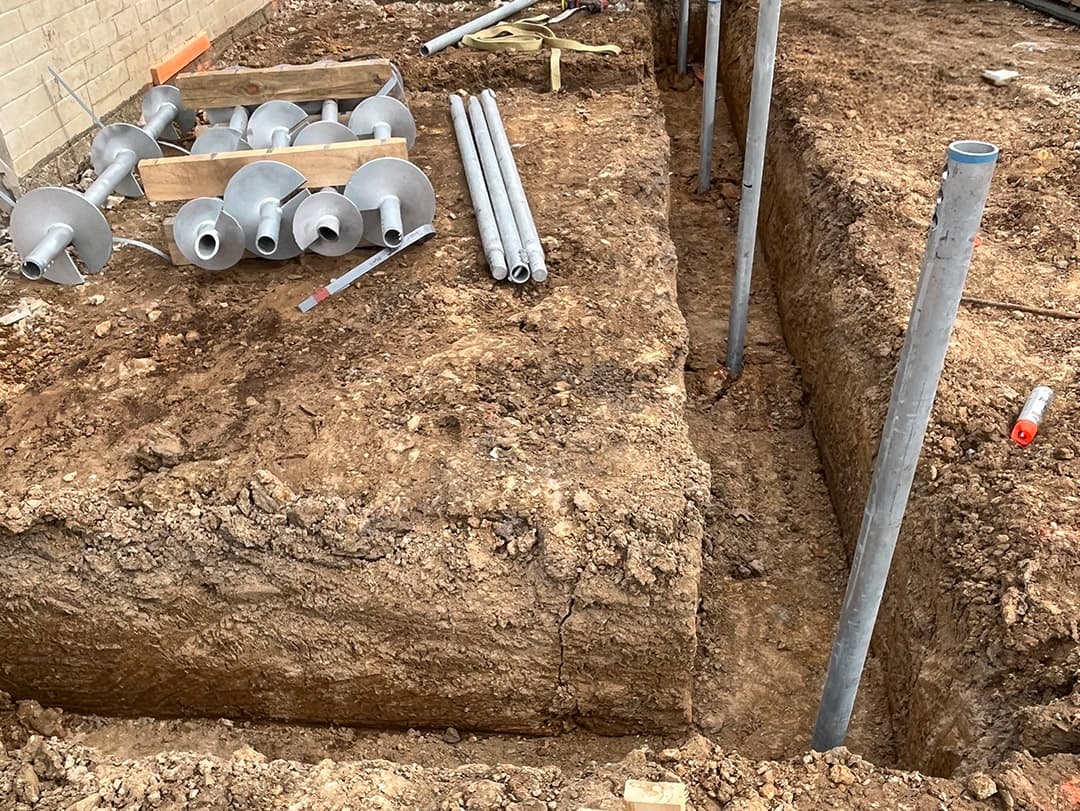
Civil Solutions designed a helical pier foundation for both the family bathroom addition and the equipment yard roof, and The Dwyer Company installed 12 piers on a 10-12-14 helix configuration with 0.217 wall shaft. Each pier advanced between 10 and 16 feet, past the soft upper soils and into the stiff to very stiff material below, with 12 kips of capacity in compression and tension. The tension rating matters on a roof structure, where wind uplift pulls on the foundation as readily as the dead load pushes on it.
Installation ran on compact equipment, which let crews set piers close to the existing buildings without excavating alongside them or disturbing the soils supporting them. Torque readings during the install confirmed each pier reached bearing, so the crew knew the capacity was there before the caps went on. The Dwyer Company coordinated with Garmong & Sons, Inc on site and turned the foundation over in two days.
The Impact
Three results carried the job at Deming Park Pool.
Bearing below the soft soils
All 12 piers extended past the soft upper material into stiff to very stiff soils, giving both additions a foundation designed for 12 kips in compression and tension.
Built tight to existing structures
Helical piers went in beside the existing buildings with small equipment and minimal excavation, so the structures already standing kept their support.
Two days on the schedule
The foundation was complete in two days, which handed Garmong & Sons, Inc the site back quickly for the addition work above it.
Why Helical Piers?
Helical piers gave The Dwyer Company a way to reach competent bearing beneath soft soils on a site where excavation next to existing buildings would have caused its own problems.
- Bypass poor soils – Piers advance until the helices reach a bearing stratum, so depth follows the soil profile at each location.
- Verified capacity – Installation torque correlates to capacity, giving pier-by-pier confirmation as the work proceeds.
- Tension and compression in one system – A single helical pier resists uplift and downward load, which suits roof structures and additions alike.
- Low disturbance next to existing construction – Compact equipment and small excavations keep the work away from the soils holding up neighboring structures.
- Cold weather installs – Piers take load once they are connected, with no cure time to schedule around in February.
Why Choose The Dwyer Company for structural integrity?
Deep History • Solid Choice
The Dwyer Company’s proven track record in commercial and industrial foundation systems made us the trusted partner for the additions at Deming Park Pool. Working with Civil Solutions and Garmong & Sons, Inc, the team put 12 helical piers into stiff bearing soils in two days so construction above could move ahead.
Have a project sitting on soft soils?